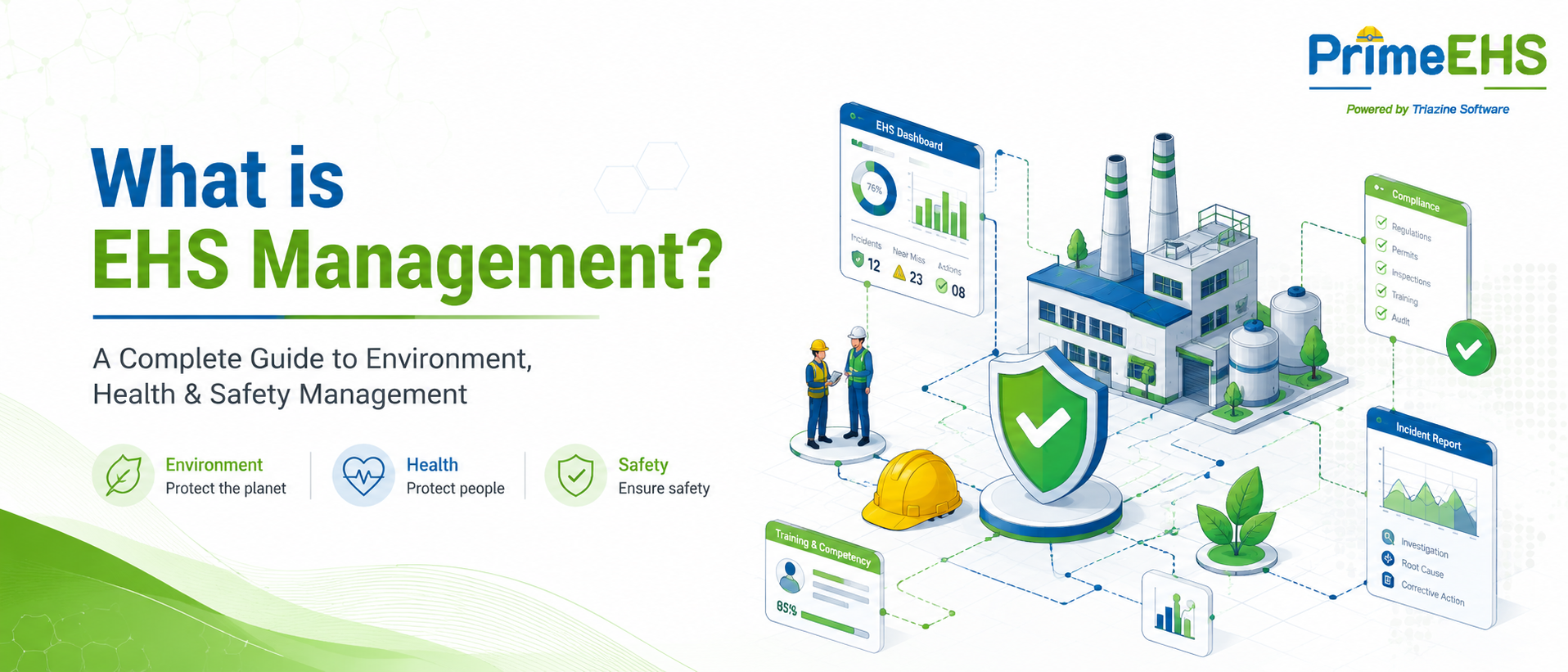
EHS management is the systematic practice of identifying, controlling, and reducing environmental, health, and safety risks across an organisation. It combines policies, processes, training, and technology to protect employees, the surrounding environment, and business operations from harm while keeping the organisation compliant with regulatory requirements.
If you manage a plant, a warehouse, a construction site, or any operation where people, equipment, and hazardous materials interact, EHS management isn't optional. It keeps people alive, satisfies regulators, and helps operations run without costly shutdowns.
This guide breaks down what EHS actually means, how the system works, why it matters more in 2026 than ever, and how to build or upgrade an EHS program that actually functions instead of living in binders nobody opens.
What Does EHS Stand For?
EHS stands for Environment, Health, and Safety. Some organisations write it as EHS&S (adding Sustainability) or reorder it as HSE or SHE; these all refer to the same core discipline, just with different naming conventions depending on the industry or region.
A Brief Evolution of EHS Management
EHS wasn't always a formal discipline. For most of industrial history, workplace safety was reactive; organisations addressed hazards only after an accident forced them to do so. Major industrial disasters throughout the 20th century exposed how dangerous unregulated workplaces could be, and pushed governments to introduce dedicated occupational safety regulations and environmental protection standards.
Over the following decades, EHS shifted from a purely regulatory obligation into a structured management discipline. Organisations began building dedicated EHS departments, formal risk assessment methods, and internal auditing processes. More recently, three forces have reshaped EHS again:
- Digitisation: replacing paper forms and spreadsheets with real-time reporting and centralised data.
- Predictive analytics: using near-miss and observation data to prevent incidents rather than just record them.
- ESG and sustainability pressure: extending EHS beyond compliance into a factor that investors, customers, and regulators actively track.
Today, EHS management sits at the intersection of risk management, operational efficiency, and corporate accountability- which is exactly why organisations that still treat it as a compliance checkbox tend to fall behind.
The 3 Pillars of EHS Management
Every EHS program is built on three interconnected pillars. Understanding each one individually is the first step toward managing them as a coordinated system rather than three separate checklists.
1. Environment
This pillar covers how an organisation's operations affect air, water, soil, and the surrounding community. It includes:
- Emissions and waste management
- Chemical spill prevention and response
- Resource consumption tracking
- Environmental compliance reporting
2. Health
The health pillar protects employees, contractors, and nearby communities from exposure to hazardous substances, pathogens, radiation, noise, and other occupational health risks. It includes:
- Industrial hygiene monitoring
- Occupational health surveillance
- Ergonomics programs
- Exposure limit tracking
3. Safety
The safety pillar is focused on preventing workplace accidents and injuries in real time. It includes:
- Hazard identification and risk assessment (HIRA)
- Permit-to-work systems for high-risk tasks.
- Incident and near-miss reporting
- Personal protective equipment (PPE) compliance
These three pillars don't operate independently; a chemical spill (Environment) can create a health hazard (Health) and trigger an emergency safety response (Safety) all at once. That overlap is exactly why organisations need a single connected system rather than three disconnected ones.
What is an EHS Management System?
An EHS management system (EHSMS) is the structured framework of policies, procedures, roles, and tools that an organisation uses to plan, execute, monitor, and continuously improve its EHS performance. Rather than reacting to incidents after they occur, a mature EHSMS is built to proactively identify risks and close them before they lead to injuries, violations, or environmental damage.
Core Components of an EHS Management System
| Component | What It Does |
|---|---|
| Hazard Identification & Risk Assessment (HIRA) | Identifies potential hazards before they cause harm and scores their risk level |
| Permit to Work (PTW) | Controls and authorizes high-risk activities like hot work, confined space entry, or electrical work |
| Incident Management | Captures, investigates, and tracks incidents and near-misses to root cause |
| Audit & CAPA | Runs scheduled audits and tracks Corrective and Preventive Actions to closure |
| Compliance Management | Tracks applicable regulations, licenses, and statutory obligations |
| Training & Competency (LMS) | Ensures every employee is trained and certified for the tasks they perform |
| Asset Management | Tracks equipment inspections, certifications, and maintenance schedules tied to safety |
| Management of Change (MoC) | Assesses and controls the risk introduced by process, equipment, or organizational changes |
| Document Control | Keeps SOPs, policies, and certificates current and audit-ready |
| Reporting & Analytics | Turns EHS data into leading indicators, not just after-the-fact reports |
EHS vs. ESG vs. Sustainability: What's the Difference?
These three terms get used interchangeably, but they aren't the same thing:
- EHS is operational; it's the day-to-day practice of managing environmental, health, and safety risks inside your organisation: permits, incidents, audits, training.
- Sustainability is strategic; it's the broader effort to reduce long-term environmental impact, from carbon footprint to resource efficiency to circular design.
- ESG (Environmental, Social, and Governance) is a reporting and evaluation framework; it's how investors, regulators, and stakeholders measure an organisation's performance across environmental, social, and governance dimensions, often drawing directly on EHS data.
In practice, EHS is the operational engine that feeds both sustainability initiatives and ESG reporting. Strong EHS data incident rates, emissions tracking, and compliance status is often the raw material that sustainability and ESG teams rely on. Organisations that treat these as three disconnected functions end up duplicating data collection three times; those that connect them save significant time and achieve more accurate reporting. Regular cross-functional EHS meetings with documented action tracking are often what keeps this alignment from breaking down between departments.
Why EHS Management Matters
The case for EHS management isn't just moral; it's financial and operational.
- Cost of incidents: A single medically consulted workplace injury commonly exceeds the cost of the entire prevention program that could have avoided it.
- Regulatory exposure: Non-compliance can trigger fines, license suspensions, or forced shutdowns, all of which cost far more than proactive compliance management.
- Operational continuity: Every incident, audit failure, or environmental violation disrupts operations. A functioning EHS system reduces unplanned downtime.
- Workforce trust: Employees who see a genuine safety culture tend to stay longer, report hazards more openly, and perform better; turnover in high-risk roles drops when people trust the system protecting them.
- Competitive and investor pressure: With ESG scrutiny increasing, EHS maturity is becoming a factor investors and customers actively evaluate, not just a back-office function.
Organisations with higher EHS maturity consistently report fewer incidents, less downtime, and stronger audit readiness than those still managing EHS on spreadsheets and paper forms.
EHS by the Numbers
The scale of workplace risk and the return on managing it well is easier to grasp with hard data:
- Nearly 3 million workers die every year from work-related accidents and diseases combined, according to the International Labour Organisation (ILO), with work-related diseases accounting for the large majority of that toll and accidents responsible for roughly 330,000 deaths.
- The ILO has also estimated that for every fatal workplace accident, there are hundreds to thousands of additional injuries, depending on the type of work involved.
- Work-related deaths and injuries cost the economy, employers, and individuals more than $1.3 trillion in a single recent year, according to National Safety Council estimates cited by OSHA.
- Employers pay over $1 billion per week in direct workers' compensation costs alone for serious nonfatal workplace injuries, per OSHA and Liberty Mutual data.
- The average workplace injury costs more than $40,000 in direct expenses, not counting lost productivity, replacement training, or reputational damage.
- Over 60% of surveyed finance leaders report that every $1 invested in injury prevention returns $2 or more, making EHS one of the rare compliance functions with a measurable ROI.
- Adoption of occupational safety certification has grown; ISO 45001 certificates have expanded well beyond 185,000 worldwide since the standard replaced OHSAS 18001, with continued double-digit annual growth.
- OSHA's "Fatal Four" - falls, being struck by an object, electrocution, and being caught in or between equipment - remain the leading causes of fatalities in high-risk sectors like construction, underscoring why hazard-specific controls, not generic policies, save lives.
The takeaway across all of these numbers: workplace risk is large, measurable, and critically preventable with the right systems in place.
EHS Challenges by Industry
While the core principles of EHS stay consistent, the specific risks and priorities shift depending on the industry:
- Manufacturing: Machine guarding, equipment lockout/tagout, repetitive strain injuries, and managing hazardous materials on the production floor. This spans sectors like automobiles, iron and steel, and cement.
- Oil, Gas & Refinery: High-consequence hazards like confined space entry, hot work, and process safety management, where a single lapse can be catastrophic. The power sector faces closely related risks.
- Construction & Infrastructure: Constantly changing job sites, subcontractor safety management, fall protection, and heavy equipment coordination.
- Chemicals & Fertiliser: Strict handling and storage protocols, spill response planning, and exposure monitoring for hazardous substances.
- Metal & Mining: Ground stability, ventilation, confined spaces, and remote-site emergency response.
- Shipping & Marine: Vessel and port safety, cargo handling risk, and multi-jurisdictional compliance.
- Food, FMCG & Agriculture and Retail & Consumer Durables: Hygiene and food-safety compliance alongside standard workplace and logistics risk.
The common thread across every industry is that risks that go untracked don't disappear — they resurface later as incidents, audit failures, or regulatory penalties. A generic EHS approach rarely works well across all of these; the strongest programs adapt core EHS processes to the specific hazard profile of the industry they operate in.
Regulatory Frameworks and Standards
EHS management doesn't operate in a vacuum; most organisations align their programs with recognised international standards:
- ISO 45001: the international standard for occupational health and safety management systems, focused on reducing workplace injury and ill health.
- ISO 14001: the international standard for environmental management systems, focused on reducing environmental impact and improving resource efficiency.
- ISO 14064 / GHG Protocol: frameworks for measuring and reporting greenhouse gas emissions, increasingly relevant as carbon accounting and energy, water, and waste tracking become part of EHS scope.
Certification against these standards isn't mandatory for every organisation, but even without pursuing formal certification, using them as a structural reference provides an EHS program with a proven framework rather than building one from scratch. Many organisations start by adopting ISO 45001 internally, then pursue formal certification once the system matures.
Manual EHS Process vs. EHS Software
Many organisations still run EHS through spreadsheets, paper checklists, and email threads. Here's how that compares to a digital, connected EHS system:
| Manual / Paper-Based EHS | Digital EHS Management | |
|---|---|---|
| Incident reporting | Delayed, often lost in transit | Instant, from any device, real-time alerts |
| Audit tracking | Manual follow-up, easy to miss deadlines | Automated CAPA workflows with due-date tracking |
| Compliance visibility | Scattered across files and folders | Centralized dashboard, always audit-ready |
| Permit approvals | Physical signatures, slow turnaround | Digital approval chains, instant authorization |
| Data for decisions | Lagging indicators only, after the fact | Leading indicators, trend analysis, predictive insight |
| Scalability | Breaks down as sites/headcount grow | Scales across sites, teams, and geographies |
The shift from manual to digital isn't about replacing people; it's about giving EHS teams visibility and speed they simply can't get from paper.
How to Implement an EHS Management System: Step by Step
- Assess your current risk landscape. Map every hazard across your sites physical, chemical, biological, and environmental.
- Define policies and objectives. Set clear EHS goals aligned with regulatory requirements and business priorities.
- Assign ownership. EHS shouldn't rest with a single person; build a structure with site-level responsibility and central oversight.
- Standardise processes. Build consistent workflows for permits, incident reporting, audits, and training across every location.
- Train your workforce. Every employee should know the hazards relevant to their role and how to report issues immediately.
- Digitise and centralise. Move from paper and spreadsheets to a connected system so data flows in real time, not in monthly batches.
- Monitor with leading indicators. Track near-misses, observations, and audit trends, not just injury counts after the fact.
- Review and improve continuously. Use CAPA cycles to close gaps and revisit your risk assessments as operations change.
Common EHS Management Mistakes to Avoid
Even well-intentioned EHS programs fail for predictable reasons. Watch out for these:
- Treating EHS as a compliance-only function. Compliance is the floor, not the goal. Programs built solely to pass audits often overlook the risks that actually cause incidents.
- Relying on lagging indicators alone. Tracking injury counts after the fact tells you what already went wrong, not what's about to.
- Fragmented data across sites. When each location keeps its own spreadsheets, there's no way to spot company-wide patterns until it's too late.
- Under-investing in training. A well-designed EHS system still fails if employees don't understand it or don't trust it enough to report honestly.
- No clear ownership. When everyone is "responsible for safety," in practice no one is accountable for closing specific gaps.
- Ignoring near-misses. Near-misses are free warnings; organisations that don't track them lose the earliest signal they'll ever get before a real incident occurs.
Key EHS Metrics and KPIs to Track
Measuring EHS performance well means balancing two types of indicators:
Lagging indicators (what already happened):
- Total Recordable Incident Rate (TRIR)
- Lost Time Injury Frequency Rate (LTIFR)
- Number of regulatory violations or fines
- Days away, restricted, or transferred (DART) rate.
Leading indicators (what predicts what's coming):
- Near-miss reporting rate
- Percentage of scheduled audits/inspections completed on time
- CAPA closure rate and average time to close
- Percentage of employees current on required training
- Number of safety observations logged per site
Organisations that only track lagging indicators are, by definition, always looking backwards. The programs that reduce incident rates over time treat leading indicators as the primary dashboard and lagging indicators as the scorecard.
Building a Strong EHS Culture
Systems and software only work if the people using them actually believe in them. A few practices separate organisations with a genuine safety culture from ones that just have a safety policy:
- Make reporting easy and blame-free. If reporting a near-miss feels risky or bureaucratic, people stop doing it.
- Involve frontline workers in risk assessments. The people doing the work usually spot hazards that a policy document misses.
- Close the loop visibly. When someone reports an issue, show them that it led to a fix; this builds long-term trust in the system.
- Make leadership visible on safety. When leadership regularly walks the floor, tracks EHS metrics, and acts on them, it signals the priority is real, not just written down.
- Recognise proactive behaviour, not just clean incident counts. Rewarding people for reporting hazards early builds a stronger culture than only rewarding zero-incident streaks, which can quietly discourage honest reporting.
Choosing EHS Management Software: A Quick Checklist
When evaluating EHS software, look for a platform that covers these fundamentals rather than a narrow point solution:
- Incident and near-miss management with root cause analysis
- Digital permit to work with approval workflows
- Audit and CAPA tracking with automated reminders
- Compliance and statutory obligation tracking
- Built-in LMS for training and certification tracking
- Observation and risk management tools for frontline hazard reporting
- Mobile access for field teams and site inspections
- Real-time dashboards and analytics, not just static reports
- Ability to scale across multiple sites and business units
Frequently Asked Questions
What are the 3 pillars of EHS?
The three pillars of EHS are Environment, Health, and Safety. Together, they cover environmental impact, occupational health, and workplace safety as a single, coordinated discipline.
Is EHS the same as HSE?
Yes. EHS and HSE (and SHE) refer to the same discipline, Environment, Health, and Safety, just ordered differently depending on regional or industry conventions.
What does an EHS manager do?
An EHS manager owns the EHS program end-to-end: conducting risk assessments, managing incident investigations, running audits, tracking compliance obligations, and delivering safety training across the organisation.
Is EHS management the same as ISO 45001?
No. ISO 45001 is a certifiable standard for occupational health and safety management systems. EHS management is the broader discipline; ISO 45001 (along with ISO 14001 for environment) is one way to formalise and certify parts of that system.
Do small organisations need EHS software, or just large enterprises?
Any organisation, regardless of size, that manages physical risk benefits from structured EHS processes. Software becomes essential once manual tracking starts causing missed deadlines, lost records, or slow incident response, which tends to happen well before an organisation feels "large."
What is the difference between a leading and lagging indicator in EHS?
A lagging indicator measures something that has already happened, such as an injury rate. A leading indicator measures activity that predicts future outcomes, like near-miss reporting rates or audit completion rates. Strong EHS programs track both but prioritise leading indicators for prevention.
How often should EHS audits be conducted?
Frequency depends on risk level and regulatory requirements, but most mature programs run a mix of daily/weekly site inspections, monthly internal audits, and at least one comprehensive annual audit, with audit frequency increasing for higher-risk activities such as confined space work or hot work.
Can EHS management reduce insurance and operational costs?
Yes. Fewer incidents mean fewer claims, less downtime, and stronger audit outcomes, all of which directly affect insurance premiums and total operating costs. Mature EHS programs are frequently cited as a measurable cost advantage, not just a compliance expense.
What's the difference between an EHS program and an EHS management system?
An EHS program defines the policies and processes an organisation follows. An EHS management system is a structured framework that includes tools, workflows, and data to plan, execute, and continuously improve those processes. In short: the program is what you do; the system is how you run it.
Bringing It All Together
EHS management works best as one connected system rather than three separate checklists bolted together. Incident data should feed into your CAPA process. Permit approvals should connect to training records. Compliance tracking should update automatically as regulations shift. That's the difference between an EHS program that exists on paper and an EHS system that actually prevents harm.
If you're evaluating how to move from spreadsheets to a connected EHS platform, explore how PrimeEHS brings Incident Management, Permit to Work, Audit & CAPA, Compliance, and Training together in one system built for teams that need visibility across every site, not just one binder at a time.